How to Play
The full guide, from the basics to how the Classic and Modern rule-sets differ.
Build a thriving high-rise and earn your way to a coveted TOWER rating.
Mouse: drag to pan with the Inspect tool; with a build tool, hold Shift (or Space) and drag to pan, and a middle or right button drag pans too. Scroll to zoom, click to build, Inspect tool to edit a room. Made a mistake? Undo with Ctrl+Z (or the Undo button). Redo with Ctrl+Shift+Z. Music changes with whatever part of the tower you're viewing. Try scrolling around!
Touch: press and drag on the tower to build (a ghost shows where the room lands), two fingers to pan, pinch to zoom, tap a room with Inspect to edit it. Full guide under Playing on a phone below.
The basics
- Floors first. Lay Floor tiles, then place rooms on them.
- Move people. Every floor needs an elevator or stairs chain back to the ground lobby, or tenants leave.
- Make money. Offices pay quarterly rent, condos sell once, hotels earn nightly, shops & restaurants earn from foot traffic.
- Grow your rating. 2★ at 300 pop, 3★ at 1,000 (needs Security), 4★ at 5,000 (needs Medical, enough Recycling, suites & a VIP), 5★ at 10,000 (needs a Metro). At 5★ a floor-100 payoff wins the game (under Going further).
- Keep it moving. People will ride as many elevators as it takes to reach a floor, but every transfer is another wait. Add sky lobbies (every ~15 floors) and express elevators so long trips stay quick; a tower that makes people transfer over and over crawls, and they give up.
Going further
- Take out the trash. One Recycling Center processes ~2,500 population. It visibly fills through the day and a garbage truck empties it each morning. Outgrow your centers and 4★ locks until you build more.
- Win. At 5★ with a Metro station, build the Wedding Hall on floor 100 and pass the VIP inspection. The TOWER rank needs 15,000 occupants: office workers, residents, and venue customers. Hotel guests don't count at this stage, even when dining.
- Parking spaces only work when they touch a Parking Ramp or a connected space. Chain them off a ramp, or they sit empty. Offices want a space per ~24 workers (one per four offices) from 3★, and every hotel suite needs one of its own (the VIP drives).
- Book the films. Cinemas book a film monthly. A Blockbuster costs twice as much but pulls a far bigger crowd (great in a busy tower, a money-loser in a quiet one). Leave it on Auto or set a policy on the cinema.
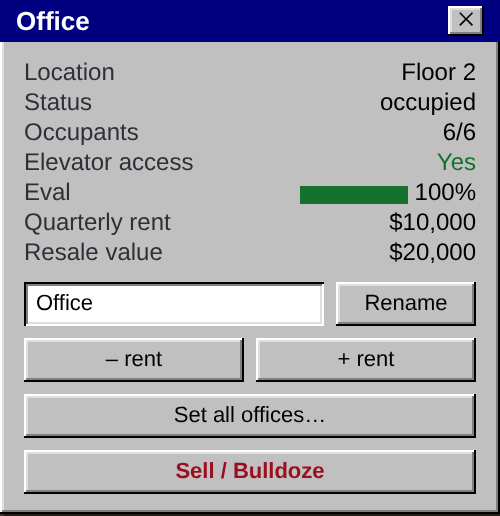
- Price in bulk. Inspect any office, condo or hotel room and use “Set all …” to re-price every unit of that kind at once (or reset them to the default). No need to edit each room. A preview shows how many change before you apply.
- The clock breathes. As in 1994, real time isn't spent evenly: the clock crawls through the lunch crush (watch your elevators earn their keep) and races through the small hours. A full day still takes the same real time, and the speed buttons still multiply it. Prefer an even pace? Toggle Steady clock in Settings.
Classic vs Modern
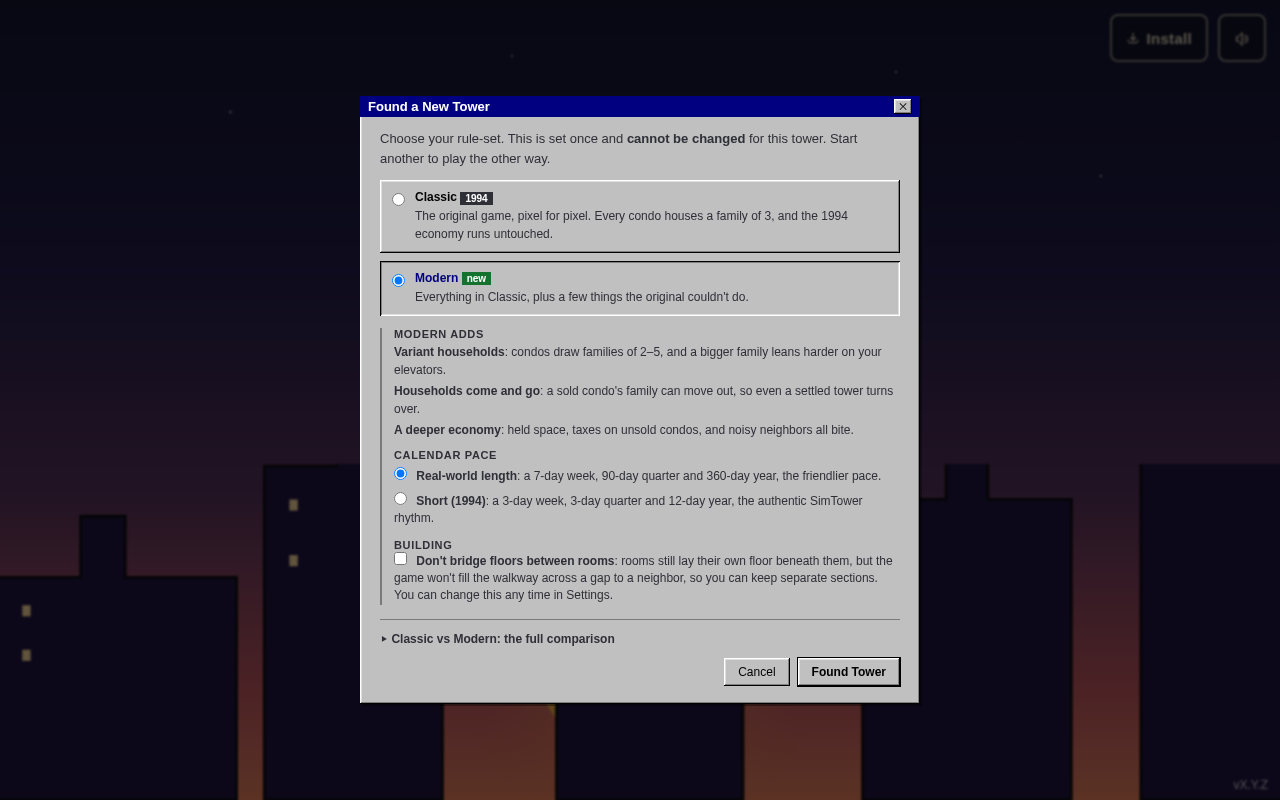
You pick a rule-set when you found a tower, and it's fixed for that tower's life. Classic is the faithful 1994 game. Modern keeps all of it and adds things the original couldn't do. Want to play the other way? Start a new tower.
- Variant households. A condo draws a 2–5 person family instead of the flat family of 3. The family sets the sale price and how demanding it is: a bigger family pays more but leans harder on your elevators.
- Households come and go. A sold condo's family can move out on its own now and then, a life event more likely for a bigger family, so you buy the condo back and resell as the tower turns over. Classic condos, once sold, stay sold.
- A deeper economy. Held space carries a monthly overhead, unsold condos are taxed, a noisy office neighbor can wear a tenant down to a move-out, and a tenant with too few reachable shops can eventually give notice. Classic runs the 1994 economy untouched, where late-game money gets comfortable.
- Continuous pricing. Set any rent on a slider. Classic keeps the 1994 four-rung price menu plus the "No Rate" off-market option.
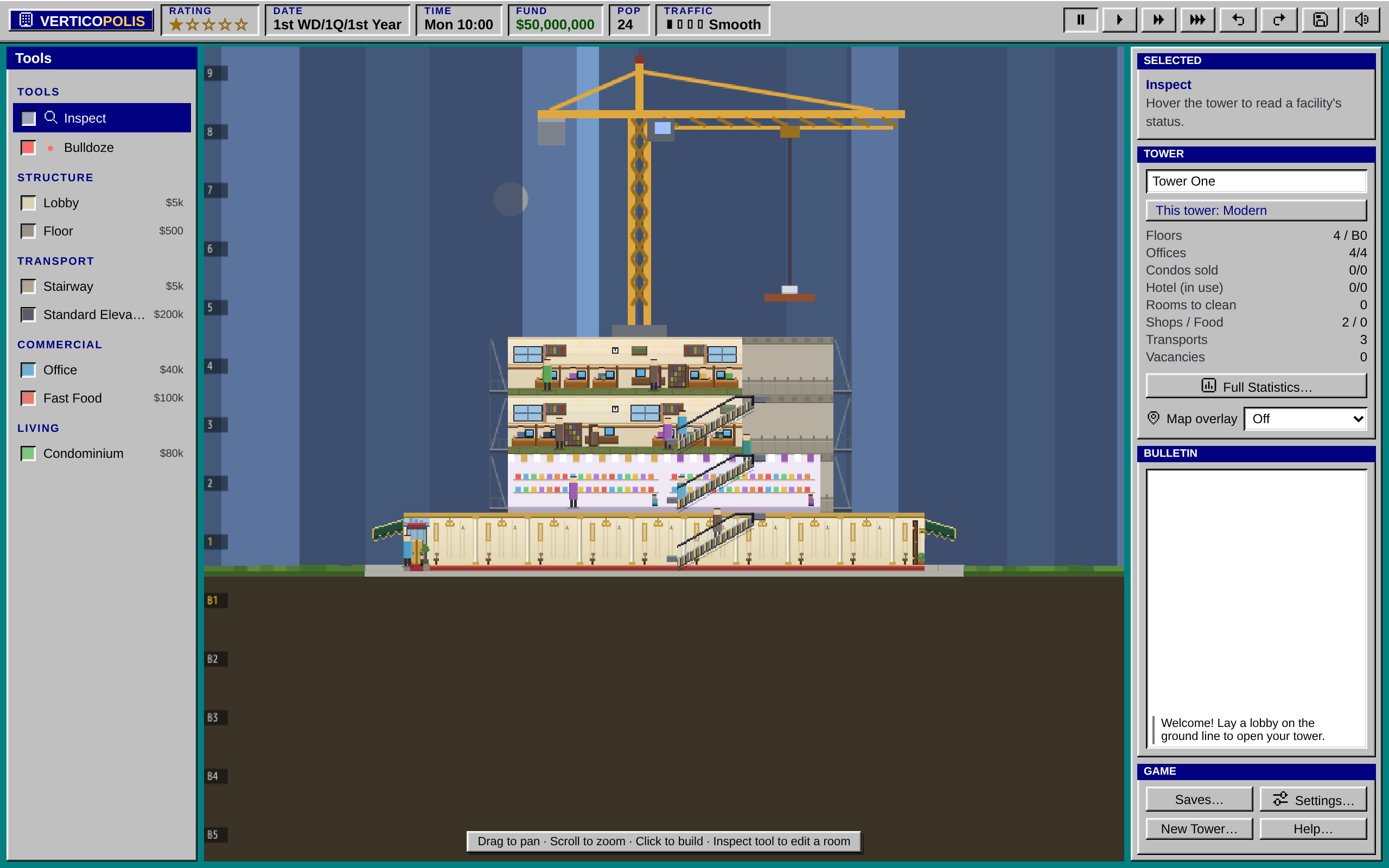
- Freer building. Escalators can serve office floors. Classic keeps escalators to commercial floors only, the way the original did.
- New places to build. Modern adds venues the original never had: the Food Hall (a hall of food stalls), Amusements (an arcade and games hall of classic cabinets, VR, claw machines, and mini-golf), and the Boutique Bay (a bay of small trades: florist, barber, phone repair, vintage, tattoo, record store, and gallery). All three earn from foot traffic and are busier on weekends. Two more pay a lease like an office instead of earning from foot traffic: the Fitness Club (weight floor, yoga, spin, boxing, climbing), which also makes nearby condos a little happier (a bonus strongest on its own floor that fades with distance), and the Clinic (dental, urgent care, optometry, pharmacy, physio), a quiet, steady tenant. And the Nightclub, which fills after dark (earning when the office crowd has gone home) but pays a monthly DJ booking, and whose noise makes nearby condos and hotel rooms unhappy, so keep it away from where people sleep. And the Spa, a wellness spa that earns from foot traffic. Where the nightclub disturbs the homes around it, the spa does the opposite for hotels: its calm makes hotel rooms on nearby floors rest a little easier (a bonus that fades with distance). And the Sky Bar, a rooftop cocktail lounge that fills in the evening and earns more the higher you place it: the skyline view is the draw, so a bar up top pours far more than one down low. And the Aquatic Center, a two-story swimming pool that, like a cinema, draws a real crowd who come to swim and lounge (so it earns from how full it is and leans on your elevators to move everyone). And the Daycare, which earns from parents dropping off and collecting kids (busiest on weekdays, not weekends) and lifts condos on nearby floors, most of all the biggest families who lean on childcare the most (a bonus that grows with family size and fades over the next few floors). These venues unlock once your Modern tower reaches 3 stars: until then they stay hidden from the build menu, the way the original hid what you had not yet earned. Classic builds only the 1994 catalog.
- Homes you rent, not just sell. Modern adds two rental residences alongside the condo, so a tower can earn a monthly rent instead of a one-time sale. The Studio is small, cheap, and easygoing: it unlocks at 2 stars, and while a noisy neighbor will annoy its tenant it will not drive them out, so a row of them suits the scrappy low floors. The Apartment unlocks at 3 stars and pays considerably more, but it is fussy: it minds noise, a long walk to the elevator, a far lobby, and a rent above the going rate, and it will give notice you can still rescind by fixing the cause in time. Either one earns nothing while it sits empty, and both stay hidden in Classic, which sells condos only.
- Longer climbs. In Modern, people will climb any number of stairs or escalators to reach a floor, so a floor served only by a long walk-up stays reachable. Classic keeps the 1994 limit: a person refuses a run longer than 4 flights of stairs or 7 of escalators (a mixed run takes the stricter of the two), so a floor that needs a longer climb can't be reached at all until you add an elevator. A reachable floor that sits far from a lobby still feels the usual distance pressure, eased by building a sky lobby nearer to it.
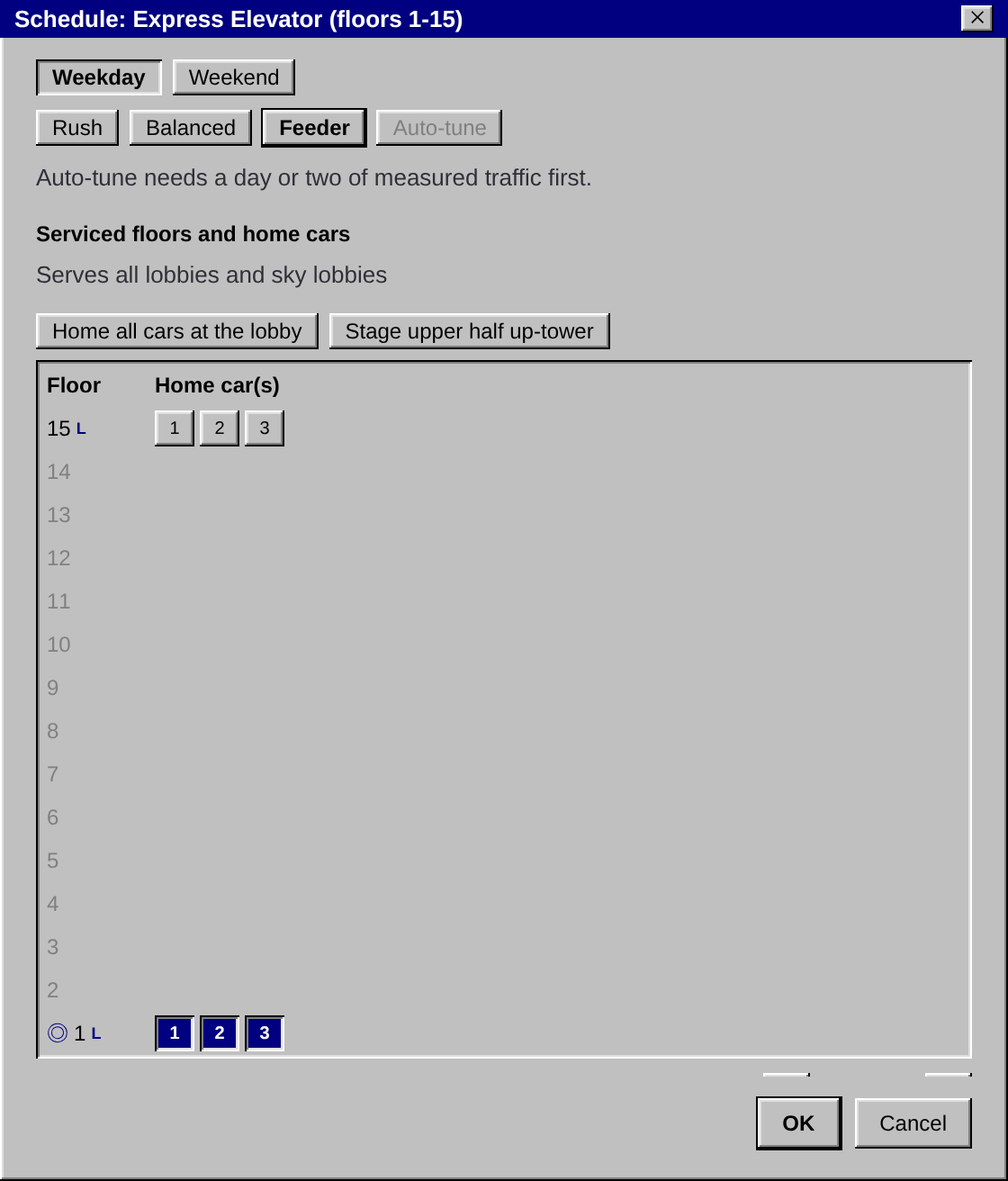
- Smarter scheduling. The per-shaft elevator schedule offers presets, a one-tap auto-tune from measured demand, and advice on the hours a shaft is overstaffed or understaffed. Classic gives you the raw grid to set by hand, the way the original did.
- Cockroach recovery. An infested hotel room can be cleared by a paid exterminator. In Classic an infestation is permanent, so the bulldozer is the only fix.
- Build hints. Hovering an invalid spot tells you why it's refused before you click. Classic refuses on the click with a toast, the way the original taught you.
- A livelier day. Condo kids leave for school and return, office workers run midday errands, some hotel guests linger past checkout for a lunch trip before they go, retail swings with weekdays and weekends, and rain thins the crowd more gently. Classic matches the literal 1994 visitor patterns.
- Calendar pace. Pick the friendlier real-world length (7-day week, 90-day quarter, 360-day year) or the authentic 1994 compressed calendar (3-day week, 3-day quarter, 12-day year) when you found the tower. Classic always runs the compressed one. Either Modern choice collects the same rent per in-game day, only in different lumps (day-to-day trade still follows the calendar's own weekday and weekend rhythm).
- Office rent, smoothed. Modern spreads office rent so the same tower earns the same per in-game day whichever calendar it runs. Classic collects the full 1994 rent lump every 3-day quarter (an Average office pays its whole $10,000 each quarter), the fast office money the original was known for.
Classic aims to be pixel-faithful to 1994. If something in Classic doesn't match the original, please report it so we can fix it. And if there's a "what the original couldn't do" behavior Modern doesn't have yet, suggest it too.
 Classic
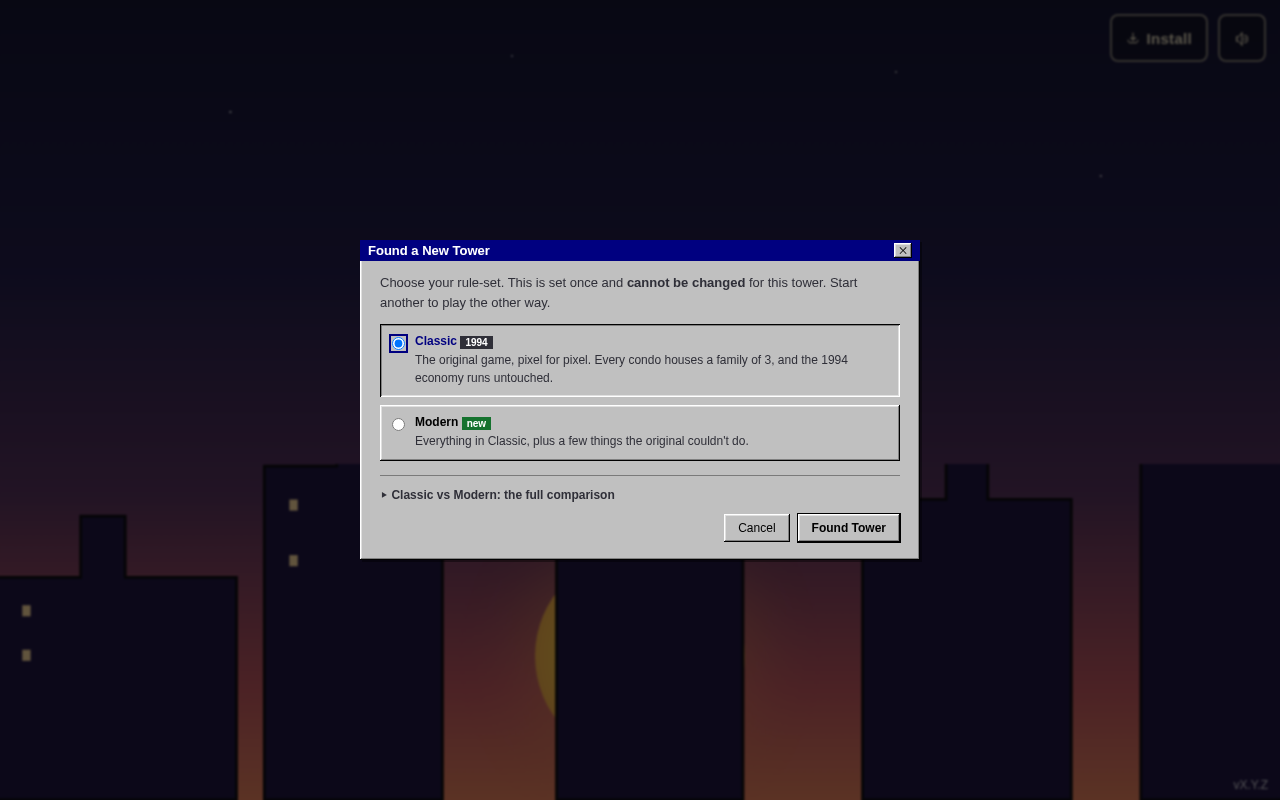
You choose the rule-set once, when you found the tower. Modern keeps every Classic behavior and adds the rest.
 Classic
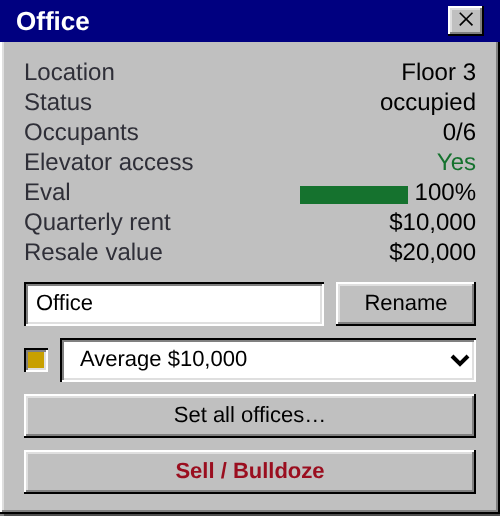
Modern prices on a continuous slider. Classic keeps the 1994 four-rung price menu plus the No Rate off-market option.
 Classic
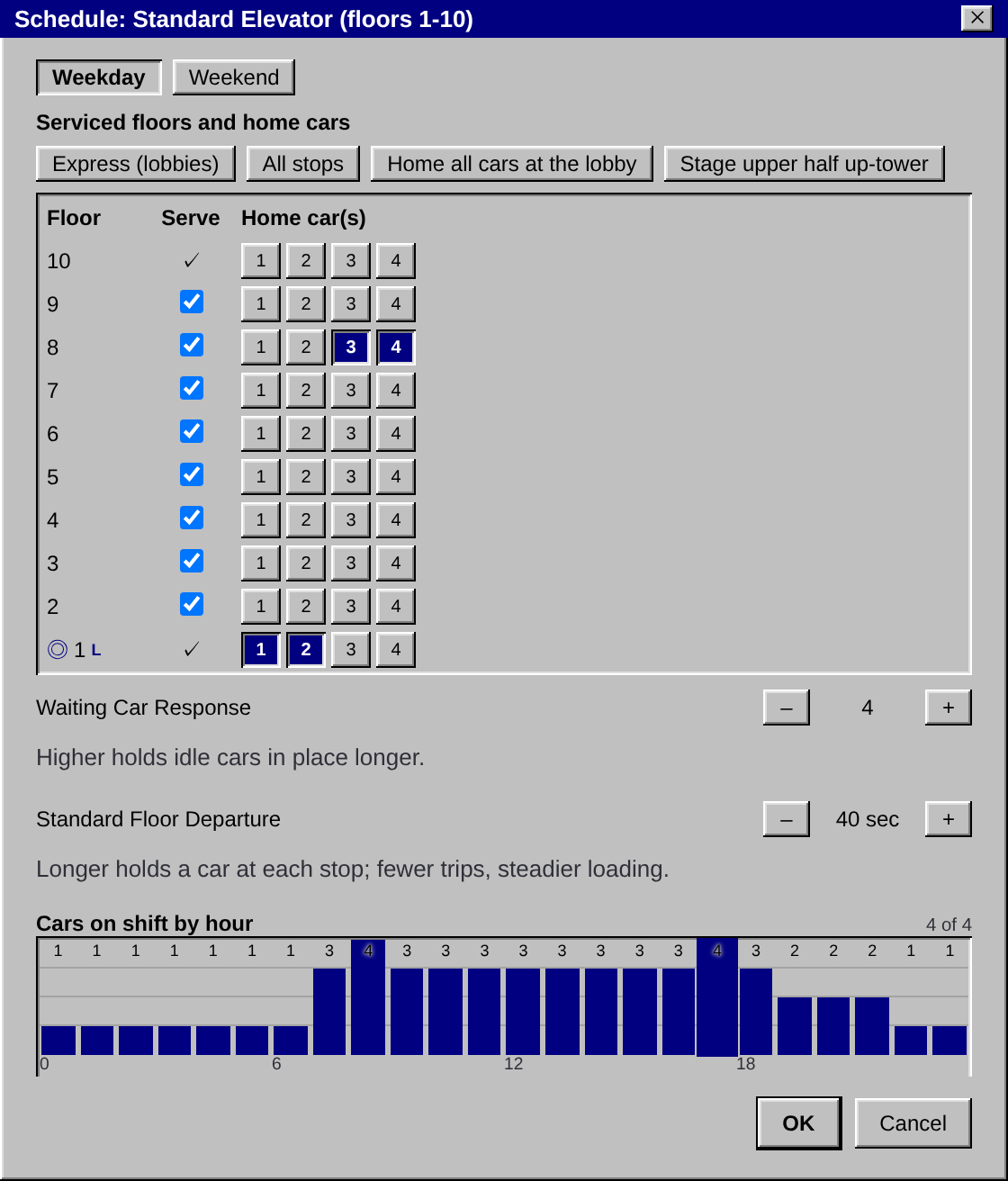
Modern offers presets, a one-tap auto-tune from measured demand, and advice on over- and understaffed hours. Classic gives you the raw 24-hour grid to set by hand.
 Classic
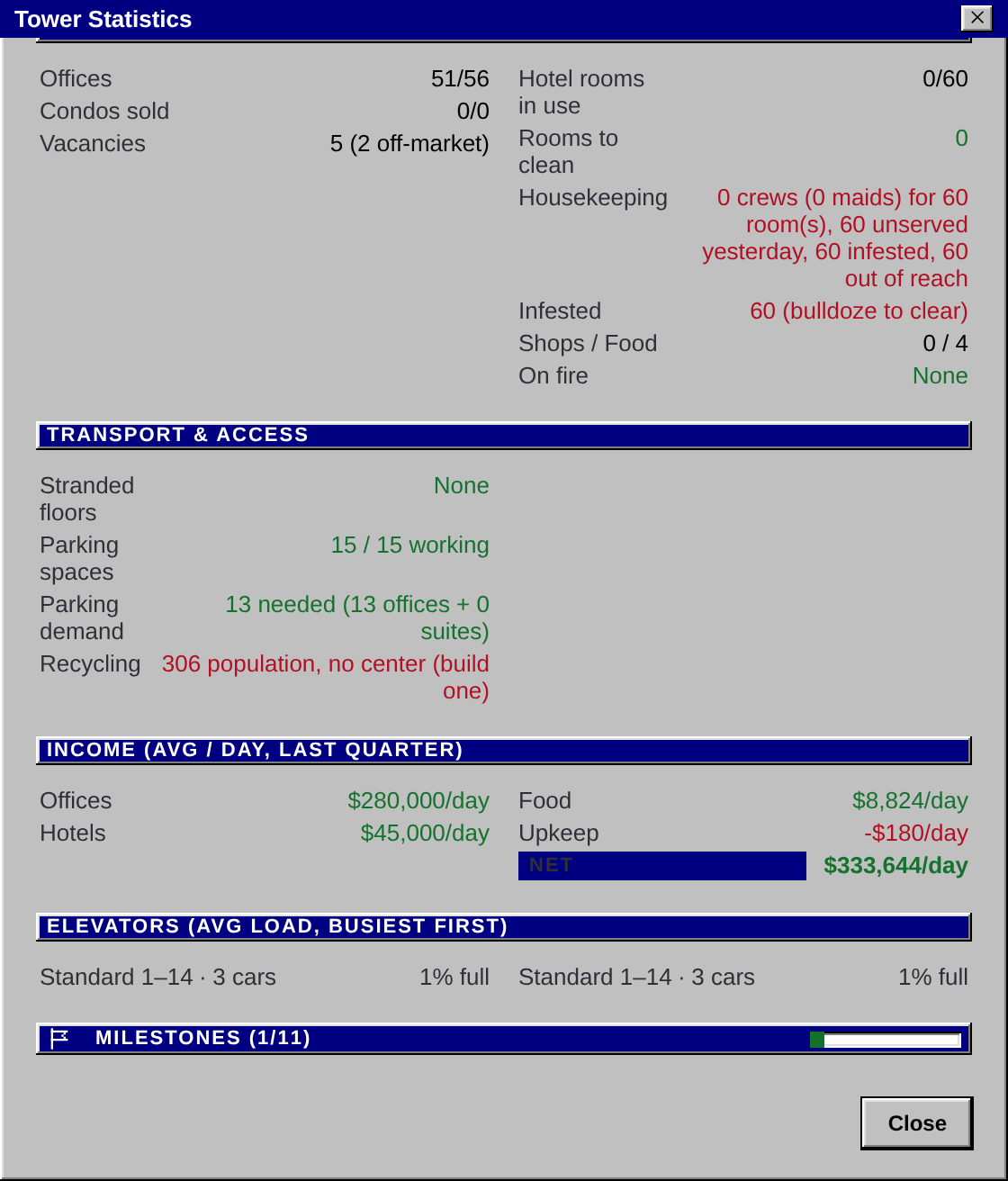
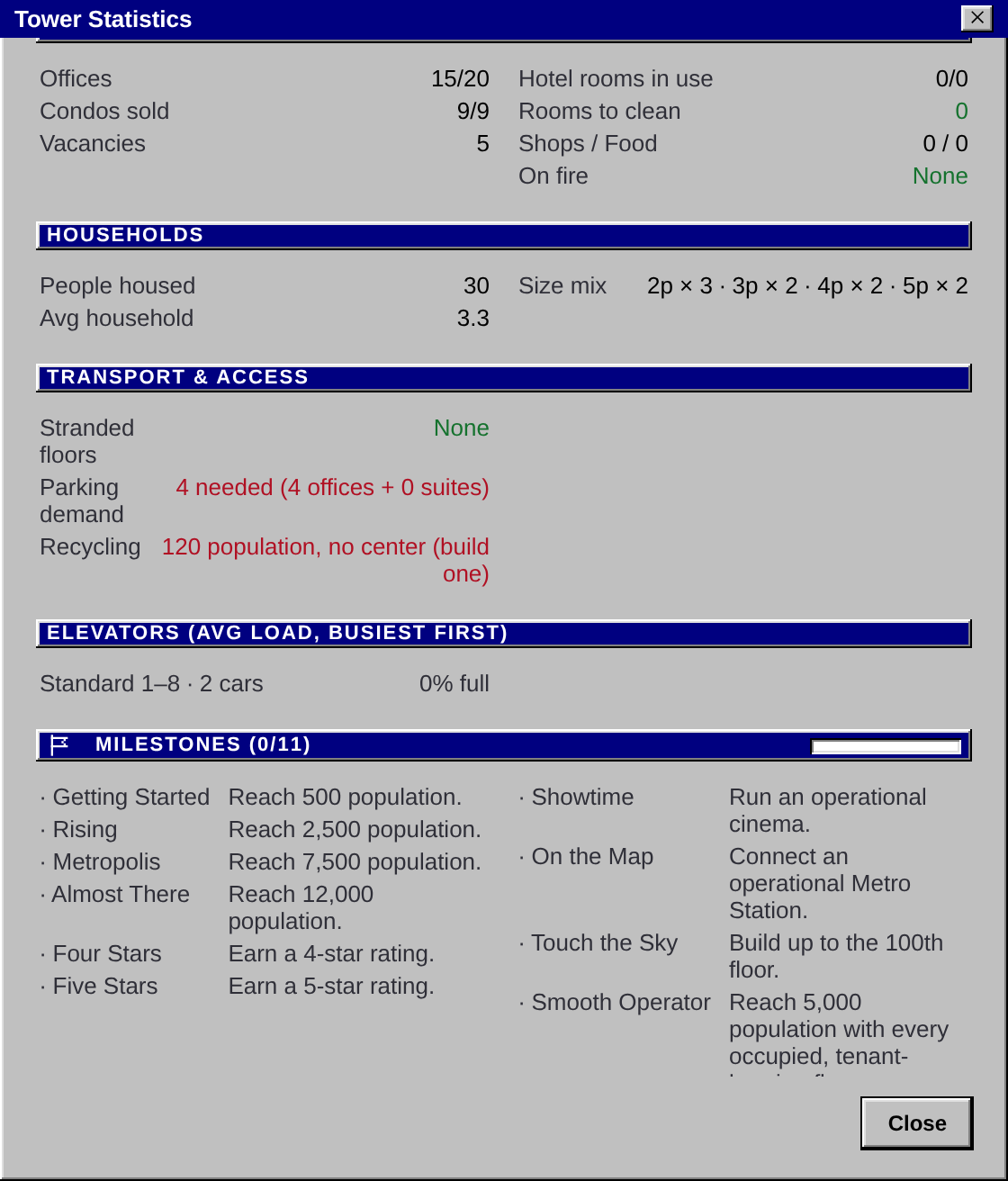
Modern tracks variant households that come and go, held-space overhead, and unmet-demand notices. Classic runs the 1994 economy untouched.
 Classic
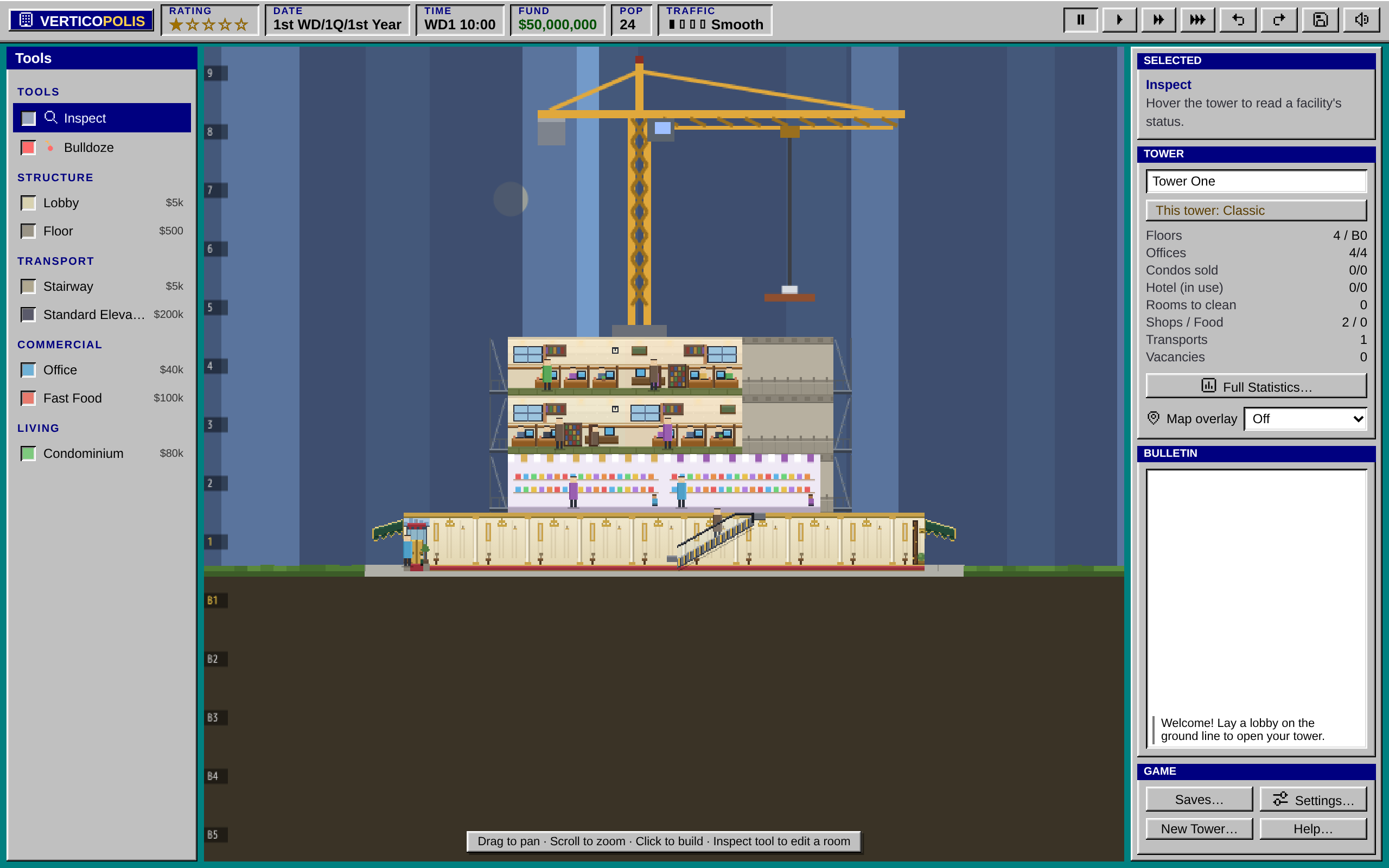
Modern lets escalators serve office floors. Classic keeps them to commercial floors only, the way the original did: the same tower keeps only its lobby-to-shops flight.
Playing on a phone
Everything works by touch. With a build tool chosen from the bottom menu:
- Place a room. Press the tower and drag: a ghost floats just above your finger so you can see where it lands, gold where it fits, red where it will not. Lift to place, or slide to a valid spot first. A quick tap drops one too.
- Lay a run. Drag with Floor, Lobby, or a Parking space to lay a whole strip at once.
- Size an elevator. Drag up or down to set a shaft's height. Stairs and escalators place with a single tap.
- Move around. Drag with two fingers to pan (or one finger with Inspect selected), and pinch to zoom.
- Peek at a room. Press and hold a room (any tool) to read its card without opening it, the way a mouse hover does. Lift to close. A quick tap still does the armed tool's action: with Inspect it opens the full panel.
- Edit or remove. Tap a room with Inspect to open its panel; tap with Bulldoze to demolish it.
- Menus. The build menu groups tools under category tabs, and a tab with a dot just gained new tools. The menu button (top bar) opens stats and the game menu, and the Undo button steps a change back.
Keyboard play
Play entirely without a mouse. Pick a tool in the palette (Tab to it, Enter to select), then:
- ↑↓←→ (or WASD) move the build cursor. Hold Shift for ×10
- Enter / Space build (or inspect) at the cursor. For an elevator or stairway, press once to anchor and again at the far end to size the shaft
- Delete / Backspace / X bulldoze at the cursor · Esc cancel
- + / − zoom · C re-center · 0–3 game speed · Ctrl+Z undo
About
An unofficial, from-scratch homage to SimTower (1994). Original code and art; no ripped assets. Not affiliated with or endorsed by Maxis / OPeNBooK / Vivarium.
Verticopolis v2.44.0
Privacy
Verticopolis keeps a small, anonymous read on how the game is going: whether new players place their first facility, how far towers climb the star ladder, which tools get used, and whether returning players get further than first-timers. Those signals are worked out on your own device and sent as coarse, anonymous counts to our own site, with no cookie and nothing that could point back to you across visits. The page also sends anonymous page-visit counts and page performance metrics.
Crash reports are the one place your own words can travel. They carry the technical details of the error and the same kind of anonymous totals, and an error message can occasionally quote a bit of game text, such as a tower's name.
There are no accounts and no ads: the game never asks for your name or email, keeps no profile, and nothing recognizes you from one day to the next. There is no consent banner, because nothing that identifies you is kept. Saves live in your own storage and leave your device only when you export them. The counts help decide what to improve; they are never sold or shared.
Found a bug? Have an idea?
Help us improve Verticopolis. Report a bug, request a feature, or flag anything that doesn't match the 1994 original.